This year MEDLINE celebrates its 45th anniversary! MEDLINE, which stands for Medical Literature and Retrieval System Online, was launched by the National Library of Medicine (NLM) in October 1971. It is the world’s premier biomedical database with 23 million bibliographic references from over 5,600 journals dating back to 1946.
How has MEDLINE changed over the past 45 years? Here’s a few interesting facts:
- In 1971, MEDLINE required a loud dial-up modem and was fee-based.
In 2016, MEDLINE is freely available to anyone with access to the Internet.
- In 1971, there were only 22 users.
So far in 2016, there have been 601 million unique visitors.
- By June 1972, there were 70,000 searches.
So far in 2016, there have been 2.8 billion searches.
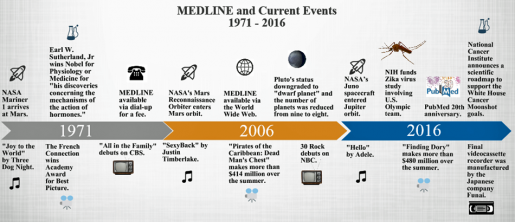
NLM created this fun timeline comparing current events to the growth of MEDLINE over the past 45 years.
People often search MEDLINE via PubMed, but don’t know what the difference is between them. MEDLINE is the largest subset of PubMed. PubMed also includes links to full-text articles and other types of articles that are considered out-of-scope for MEDLINE, primarily from general sciences and general chemistry journals, as well as other types of information. If you’re interested in learning how to use PubMed, consider taking our one hour hands-on Painless PubMed Workshop.
For more information about this notable anniversary, read “MEDLINE Celebrates Its 45th Anniversary!” in the September-October issue of the NLM Technical Bulletin.
~Jill Foust


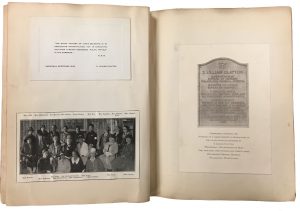 The idea of preserving memories, special moments, and histories in albums using scraps such as prints, bookplates, quotes, poems, calling cards, paper cutouts, press clippings, and photographs is not a new concept. In the United States, with the invention of photography and the appearance of a variety of patented photography and scrapbook albums, scrapbooking gained popularity in the 19th century. Today’s renewed interest in genealogy keeps the art of scrapbooking alive.
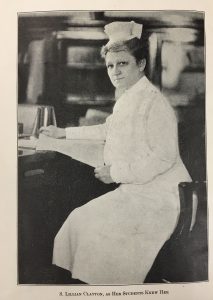 Sarah Lillian Clayton (1874-1930) was a nurse and a Superintendent of Nurses at Philadelphia General Hospital (PGH). She graduated from PGH Training School of Nursing in 1896 and began a nursing career that took her to Dayton, Minneapolis, and Chicago, only to return and complete her career in Philadelphia where she started. She became a national leader in nursing education, active in many organizations, and served as president of the National League for Nursing Education (1917-1920) and the American Nurses Association (1926-1930).