HSLS Information Services Blog News, updates, and whimsy

September 19, 2008

ISI Web of Knowledge update

Filed under: HSLS Resource Update,ISI — rebecca @ 4:04 pm

In a previous ISI WoK update, I mentioned ResearcherID.
www.researcherid.com
One part of this feature is ResearcherID Labs. There is a new tutorial available for using ResearcherID Labs at:

www.brainshark.com/brainshark/vu/view.asp?pi=820760240

Briefly, ResearcherID Labs let you VISUALIZE either the collaborative OR the citing article relationships for a researcher’s work by
–topical catagories
–countries
–institutions
–global map

topics2.jpg

global.jpg

(Note that only records added from Web of Science are included in the Collaboration Network and Citing Articles Network displays.)

–Rebecca

September 18, 2008

Information Mtg Minutes Sept 16 2008

Filed under: meeting minutes — klem @ 11:51 am

information meeting minutes Sept 16 2008

September 17, 2008

RSS feeds for new items in collection

Filed under: Odds & Ends,Web 2.0 Tools — melissa @ 11:41 am

I thought this was interesting…not sure if it’s used much by the UCLA faculty.

 http://www2.library.ucla.edu/libraries/6453.cfm

September 16, 2008

There is no such thing as a digital generation

Filed under: Odds & Ends — klem @ 11:25 am

Interesting commentary in The Chronicle of Higher Education about the myth of digital youth and the assumptions and biases that underlie attempts to simply define any generation:

http://chronicle.com/free/v55/i04/04b00701.htm

September 12, 2008

Stat!Ref updates


/* Style Definitions */ table.MsoNormalTable {mso-style-name:”Table Normal”; mso-tstyle-rowband-size:0; mso-tstyle-colband-size:0; mso-style-noshow:yes; mso-style-priority:99; mso-style-qformat:yes; mso-style-parent:””; mso-padding-alt:0in 5.4pt 0in 5.4pt; mso-para-margin-top:0in; mso-para-margin-right:0in; mso-para-margin-bottom:10.0pt; mso-para-margin-left:0in; line-height:115%; mso-pagination:widow-orphan; font-size:11.0pt; font-family:”Calibri”,”sans-serif”; mso-ascii-font-family:Calibri; mso-ascii-theme-font:minor-latin; mso-hansi-font-family:Calibri; mso-hansi-theme-font:minor-latin;}

Recent updates include 2 good descriptions of ACP resources:

ACP PIER: The Physicians’ Information and Education Resource
American College of Physicians (2008)

PIER© is a collection of over 400 evidence summaries published by the American College of Physicians. Each module provides authoritative guidance to improve the quality of care. Topics are selected based upon prevalence in clinical settings. Evidence is then gathered by literature review and evaluated based on formal criteria. The level of evidence for each recommendation is displayed clearly within the application. This resource also includes topics in complementary and alternative medicine, ethical and legal issues and procedures.

Recently Updated Modules

Amyloidosis; Cystic Fibrosis; Determining Decision-making Capacity; Disclosing a Medical Error; Distal Symmetric Polyneuropathy; Dual X-ray Absorptiometry; Dyspepsia; Female Infertility; Financial Conflicts of Interest for Physicians and Clinical Researchers; Grief Associated with Pregnancy Loss; Hemochromatosis; Hemophilia; Herpes Zoster; Homeopathy; Mitral Regurgitation; Pituitary Tumors; Prostate Cancer; Rotator Cuff Tendonitis; Routine Eye Exam; Sickle Cell Anemia; The Impaired Physician; Thoracentesis; Upper Endoscopy; von Willebrand’s Disease; Vulvar Cancer

ACP Journal Club
by Brian Haynes, MD, PhD
American College of Physicians (2008)

ACP Journal Club, published by the American College of Physicians, is the quintessential evidence-based journal and is often positioned near the top of the EBM pyramid.  Published monthly, it selects articles from the biomedical literature that report original studies and systematic reviews that warrant immediate attention by physicians attempting to keep pace with important advances in internal medicine. These articles are then summarized in value-added abstracts and commented on by clinical experts.

Selected topics from Volume 149, Number 2:

  • Therapeutics: A targeted, multifactorial intervention reduced mortality in patients with type 2 diabetes and microalbuminuria
  • Etiology: Nondiabetic maternal hyperglycemia was associated with adverse pregnancy outcomes
  • Therapeutics: An automated external defibrillator in the home did not reduce mortality in patients at risk for cardiac arrest
  • Prognosis: Melanoma of the scalp and neck had greater risk for melanoma-specific mortality than melanoma of the extremities

/* Style Definitions */ table.MsoNormalTable {mso-style-name:”Table Normal”; mso-tstyle-rowband-size:0; mso-tstyle-colband-size:0; mso-style-noshow:yes; mso-style-priority:99; mso-style-qformat:yes; mso-style-parent:””; mso-padding-alt:0in 5.4pt 0in 5.4pt; mso-para-margin-top:0in; mso-para-margin-right:0in; mso-para-margin-bottom:10.0pt; mso-para-margin-left:0in; line-height:115%; mso-pagination:widow-orphan; font-size:11.0pt; font-family:”Calibri”,”sans-serif”; mso-ascii-font-family:Calibri; mso-ascii-theme-font:minor-latin; mso-hansi-font-family:Calibri; mso-hansi-theme-font:minor-latin;}

September 10, 2008

Endnote’s Full Text Retriever

Filed under: Odds & Ends — admin @ 1:40 pm

Rebecca just posted about Science Direct’s Document Download Manager in a post below. Well, the other day I was browsing around the Endnote Website and learned that the new Endnote version (X2) has a similar feature.  It looks like this version of Endnote has a full text retriever that will identify and download the full text (if available) for records you highlight in the library.  Here is the  link Endnote’s site if you want to learn more…check out the video on what’s new.

http://www.endnote.com/

Ahlam

September 9, 2008

Bringing history online, one newspaper at a time

Filed under: Google — melissa @ 11:01 am

For more than 200 years, matters of local and national significance have been conveyed in newsprint — from revolutions and politics to fashion to local weather or high school football scores. Around the globe, we estimate that there are billions of news pages containing every story ever written. And it’s our goal to help readers find all of them, from the smallest local weekly paper up to the largest national daily.

The problem is that most of these newspapers are not available online. We want to change that.

Today, we’re launching an initiative to make more old newspapers accessible and searchable online by partnering with newspaper publishers to digitize millions of pages of news archives. Let’s say you want to learn more about the landing on the Moon. Try a search for [Americans walk on moon] on Google News Archive Search, and you’ll be able to find and read an original article from a 1969 edition of the Pittsburgh Post-Gazette.
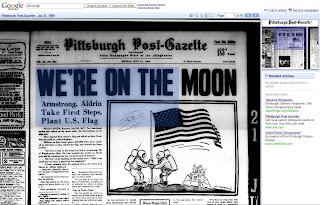
Not only will you be able to search these newspapers, you’ll also be able to browse through them exactly as they were printed — photographs, headlines, articles, advertisements and all.

This effort expands on the contributions of others who’ve already begun digitizing historical newspapers. In 2006, we started working with publications like the New York Times and the Washington Post to index existing digital archives and make them searchable via the Google News Archive. Now, this effort will enable us to help you find an even greater range of material from newspapers large and small, in conjunction with partners such as ProQuest and Heritage, who’ve joined in this initiative. One of our partners, the Quebec Chronicle-Telegraph, is actually the oldest newspaper in North America—history buffs, take note: it has been publishing continuously for more than 244 years.

You’ll be able to explore this historical treasure trove by searching the Google News Archive or by using the timeline feature after searching Google News. Not every search will trigger this new content, but you can start by trying queries like [Nixon space shuttle] or [Titanic located]. Stories we’ve scanned under this initiative will appear alongside already-digitized material from publications like the New York Times as well as from archive aggregators, and are marked “Google News Archive.” Over time, as we scan more articles and our index grows, we’ll also start blending these archives into our main search results so that when you search Google.com, you’ll be searching the full text of these newspapers as well.

This effort is just the beginning. As we work with more and more publishers, we’ll move closer towards our goal of making those billions of pages of newsprint from around the world searchable, discoverable, and accessible online.

Posted by Punit Soni, Product Manager

September 8, 2008

New! FDA Quarterly Report of Potential Safety Issues

Filed under: Consumer Health Information — rebecca @ 11:56 am

For our consumer patrons: This initial quarterly report (posted to FDA’s Web site Sept 5) lists 20 drugs along with the potential safety issue associated with each drug. Each quarter, a new report will be posted to FDA’s Web site listing additional drugs for which new safety information or potential signals of serious risks have been identified through Adverse Event Reporting System (AERS).

More info and report at: 
www.fda.gov/cder/aers/potential_signals/default.htm

–Rebecca

September 5, 2008

Grey Matters

Filed under: Literature Searching,Systematic Reviews — pat @ 4:37 pm

The Canadian Agency for Drugs and Technologies in Health (CADTH) has posted “Grey matters: an evidence-based search tool”,  a new option for searching the grey literature.

http://www.cadth.ca/index.php/en/cadth/products#greymatters

(Scroll down the page to Information Services and follow instructions to download the document.)

I haven’t test driven it yet, but will be interested in hearing what  all you systematic reviewers think of it.

Science Direct Document Download Manager

Filed under: HSLS Resource Update — rebecca @ 9:30 am

Document Download Manager, that neat new Science Direct feature that we were all excited about, became available Sept 1.

You may recall that with Document Download Manager, you can download up to 20 PDF files in one go. In a few steps you can select, download, and save multiple documents simultaneously.

–Rebecca

« Newer Posts — Older Posts »

Powered by WordPress