HSLS Information Services Blog News, updates, and whimsy

November 18, 2008

LIFE Photo Archive available on Google Image Search

Filed under: Google — melissa @ 2:42 pm

The Zapruder film of the Kennedy assassination; The Mansell Collection from London; Dahlstrom glass plates of New York and environs from the 1880s; and the entire works left to the collection from LIFE photographers Alfred Eisenstaedt, Gjon Mili, and Nina Leen. These are just some of the things you’ll see in Google Image Search today.

We’re excited to announce the availability of never-before-seen images from the LIFE photo archive. This effort to bring offline images online was inspired by our mission to organize all the world’s information and make it universally accessible and useful. This collection of newly-digitized images includes photos and etchings produced and owned by LIFE dating all the way back to the 1750s.

Only a very small percentage of these images have ever been published. The rest have been sitting in dusty archives in the form of negatives, slides, glass plates, etchings, and prints. We’re digitizing them so that everyone can easily experience these fascinating moments in time. Today about 20 percent of the collection is online; during the next few months, we will be adding the entire LIFE archive — about 10 million photos.

It has been a thrill for us to explore this archive, filled with images captured by LIFE’s famous photographers. See masters like Alfred Eisenstaedt and Margaret Bourke-White documenting pivotal world events, capturing the evolution of lifestyles and fashions, and opening windows into the lives of celebrities and everyday people.

One of our favorites is this classic Eisenstaedt image of children watching a puppet show.

Alfred snapped this in 1963, at the climax of Guignol’s “Saint George and the Dragon” in the Tuileries Garden in Paris. Just as the dragon is slain, some children cry out in a combination of horror and delight, while others are taken aback in shock. Every child is consumed with emotion, masterfully captured by Eisenstaedt’s camera. These amazing photos are now blended into our Image Search results along with other images from across the web.

Once you are in the archive, you’ll also notice that you can access a rich full-size, full-screen version of each image simply by clicking on the picture itself in the landing page. If you decide you really like one of these images, high-quality framed prints can be purchased from LIFE at the click of a button. Think of the holiday gift possibilities! It doesn’t get much easier than that.

So please take a look for yourself and experience these great photos. Your exploration will be limited only by your imagination and your desire to keep on clicking. Be sure to check back often as more photos from the LIFE archive will be added regularly to Google Image Search. We hope that you enjoy them as much as we do!

Posted by Paco Galanes, Software Engineer
November 17, 2008

Google Settlement: A Guide for the Perplexed

Filed under: Google — Tags: — admin @ 10:57 am

FYI, posted on the Chronicle’s website —

November 13, 2008

The Google Settlement: a Guide for the Perplexed

Baffled and confused by the details of the wide-ranging settlement that Google recently reached with publishers and authors over its Book Search program? Wondering what it means for you or your institution? You’re not alone.

Help is beginning to arrive, as scholarly groups and associations (and their lawyers) work their way through the sweeping settlement. The Association of Research Libraries posted today “A Guide for the Perplexed,” a 23-page analysis designed to help libraries figure out what the deal means for them.

Prepared by Jonathan Band, a copyright expert who advises the library association on intellectual-property issues, the guide lays out the basic framework of the settlement in ways that non-librarians may also find useful. It points out that the deal doesn’t apply to books published after January 5, 2009, and notes that “as a practical matter, the settlement probably will have limited applicability to in-copyright, commercially available books; the rightsholders likely will closely manage their rights in these books rather than subject them to the settlement’s general default rules.”

The guide breaks down the different free and fee-based services that will be available to users. It lays out Google’s obligations under the agreement, and gives a quick summary of legal deadlines from now to May 2009, when a court is likely to accept or reject the deal.

Look for more official dissections of and reactions to the settlement in the days and weeks ahead. —Jennifer Howard

Posted on Thursday November 13, 2008 |

Copyright © 2008 by The Chronicle of Higher Education

November 12, 2008

Two Google Items

Filed under: Google — cbwhsls @ 9:07 am

1. “New Google Tool Can Help Americans Track the Flu

Google.org, the company’s philanthropic unit, has launched a Web tool that could spot regional flu outbreaks in the U.S. as early as a week before the CDC reports them, according to the New York Times, Nov 11, 2008.

Google Flu Trends analyzes searches on influenza (e.g., “flu symptoms”) to estimate flu activity in a given area, and then uses the data to create maps of where the illness may be spreading. Google believes the site may allow people to take precautions if influenza is in their region, the Times reports.

In developing Google Flu Trends, engineers mapped 5 years of influenza-related search data to CDC reports on the flu — and found a strong correlation between the two. “We know [the tool] matches very, very well in the way flu developed in the last year,” Google.org’s executive director told the Times.

 2.  The Google library: Google’s goal of creating a giant literary database may not fit the traditional model of free public libraries. LA Times Nov 10, 2008

In a settlement announced late last month, Google, the American Assn. of Publishers and the Authors Guild agreed to give publishers more control over what went into the database and how its contents were viewed. Google could make digital copies of entire works available to public and university libraries, but with limits. Significantly, public libraries would have free access only to previews of the digitized books, and only on one computer terminal per library building. Patrons can use Google’s service to try to find a copy of a book at a nearby library, but if they want a digital copy, they’ll have to pay for it.

October 30, 2008

Google Settles Publishers’ Lawsuit Over Book Offerings

Filed under: Copyright,Google — Tags: — esaghafi @ 3:33 pm

… “Under the terms of the new agreement, through Google, consumers would be able to buy books that are out of print but retain their copyrights. The company would pay the registry 63 percent of any revenue derived from an author’s works, such as advertising placed next to online book pages.” …

Read more about it!

September 9, 2008

Bringing history online, one newspaper at a time

Filed under: Google — melissa @ 11:01 am

For more than 200 years, matters of local and national significance have been conveyed in newsprint — from revolutions and politics to fashion to local weather or high school football scores. Around the globe, we estimate that there are billions of news pages containing every story ever written. And it’s our goal to help readers find all of them, from the smallest local weekly paper up to the largest national daily.

The problem is that most of these newspapers are not available online. We want to change that.

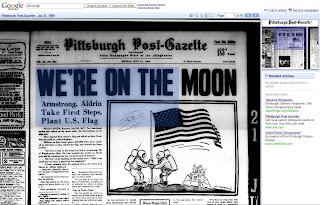
Today, we’re launching an initiative to make more old newspapers accessible and searchable online by partnering with newspaper publishers to digitize millions of pages of news archives. Let’s say you want to learn more about the landing on the Moon. Try a search for [Americans walk on moon] on Google News Archive Search, and you’ll be able to find and read an original article from a 1969 edition of the Pittsburgh Post-Gazette.

Not only will you be able to search these newspapers, you’ll also be able to browse through them exactly as they were printed — photographs, headlines, articles, advertisements and all.

This effort expands on the contributions of others who’ve already begun digitizing historical newspapers. In 2006, we started working with publications like the New York Times and the Washington Post to index existing digital archives and make them searchable via the Google News Archive. Now, this effort will enable us to help you find an even greater range of material from newspapers large and small, in conjunction with partners such as ProQuest and Heritage, who’ve joined in this initiative. One of our partners, the Quebec Chronicle-Telegraph, is actually the oldest newspaper in North America—history buffs, take note: it has been publishing continuously for more than 244 years.

You’ll be able to explore this historical treasure trove by searching the Google News Archive or by using the timeline feature after searching Google News. Not every search will trigger this new content, but you can start by trying queries like [Nixon space shuttle] or [Titanic located]. Stories we’ve scanned under this initiative will appear alongside already-digitized material from publications like the New York Times as well as from archive aggregators, and are marked “Google News Archive.” Over time, as we scan more articles and our index grows, we’ll also start blending these archives into our main search results so that when you search Google.com, you’ll be searching the full text of these newspapers as well.

This effort is just the beginning. As we work with more and more publishers, we’ll move closer towards our goal of making those billions of pages of newsprint from around the world searchable, discoverable, and accessible online.

Posted by Punit Soni, Product Manager

August 4, 2008

Dr. Web Makes Many Americans Question Trusted Health Providers

Filed under: Consumer Health Information,Google,Odds & Ends — Tags: , — admin @ 11:21 am

Dr. Web Makes Many Americans Question Trusted Health Providers

NEW YORK, July 30 /PRNewswire/ — Thirty-eight percent of U.S. adults (or
85.6 million people) say they have doubted a medical professional’s opinion or
diagnosis because it conflicted with information they found online. However,
despite the growing power of the Internet, the majority of Americans still
view health providers as their most trusted source of medical information.
In contrast, Hispanics were significantly less likely to trust healthcare
providers first, choosing to speak to family, friends and significant others
more than other races.
This research, commissioned by healthcare marketing communications
consultancy Envision Solutions, represents the first in a series of studies
examining how Americans are using various interactive technologies, including
the Internet, for health. To download a summary of the survey results, please
go to www.envisionsolutionsnow.com/healthtrust.html .
Additional Study Highlights
— Young Most Likely To Be Skeptical Of Medical Advice: Over four in ten
(43%) Americans ages 18 to 34 said they doubted their health provider’s advice
when it conflicted with online sources.
— Hispanics Least Likely To Rely On Traditional Authority Figures: Only
34% of Hispanics said they would consult their primary health provider first
if they were diagnosed with a medical condition versus 62% of whites and 61%
of African-Americans.
— Once Trusted Institutions Receive Low Marks: Overall, very few
Americans listed institutions such as government, the media and non-profits as
highly credible health information sources.
— Besides The Young, Most Do Not View Patient-Generated Content As
Credible: Despite its increasing popularity, only 3% of Americans seeking
advice about how to manage a serious medical condition would view patient
developed online health information as trustworthy. The same amount (3%) feel
this way about mild medical problems. However, 9% of 18-24 year olds are
happy to rely on this type of content for guidance on mild health conditions.
— While Trust In Internet Resources Lags, Provider-Generated Online
Content May Be Different: Previous research indicates that trust in Internet
resources is not widespread.(1) However, this study suggests credibility may
be influenced by who is authoring the content. Thirteen percent of Americans
say they would consult medical professional-developed information posted on
blogs, online forums or other Websites first if they believed they had a
health condition or disease.
Implications
This study reveals that most adult Americans instinctually trust health
providers. However, increasingly, they are using online information to
critically evaluate medical advice. It also suggests that trust in government
and non-profits has significantly eroded. Finally, health communicators and
marketers should resist overestimating the impact of patient-generated online
content on medical decision-making.
About This Research
Kelton Research, a leading polling firm, conducted a nationally
representative online survey of 1,000 U.S. adults (18+) on behalf of Envision
Solutions from July 17 – 21, 2008. This study has a margin of error of +/-
3.1 percentage points.
About Envision Solutions
Envision Solutions, LLC is a full-service healthcare marketing
communications consulting firm. Our core competencies are in the areas of
analysis, strategic and tactical recommendation development, training and
content development. Please visit www.envisionsolutionsnow.com for more
information about the firm.
(1)iCrossing, “How America Searches: Health and Wellness”, January 2008
SOURCE Envision Solutions, LLC

Fard Johnmar, Envision Solutions, LLC, +1-646-723-2341,
news@envisionsolutionsnow.com

July 30, 2008

More on Cuil (pronounced “cool”)

Filed under: Google,Odds & Ends — Tags: , , — admin @ 2:57 pm

Another one that I sent out to everyone via e-mail for the benefit of Technical Services as well. I’m posting it here for future reference.

——– Original Message ——–
Subject: The Chronicle: New Search Engine Generates Buzz Among Librarians
Date: Wed, 30 Jul 2008 10:19:41 -0700
From: Frank Mason
Reply-To: DENTALIB@usc.edu
To: DENTALIB@usc.edu

July 28, 2008

New Search Engine Generates Buzz Among Librarians

Some former Google employees have introduced a new search engine that they hope will overtake Google in popularity. The search engine is called Cuil, (pronounced “cool”) and it has been generating so much interest that its home page could not be opened at various points today.

Tom Costello, a former Stanford University researcher and one of the founders of the search engine, said Cuil culls through 120 billion Web pages, more pages than Google searches, according to an article today in The New York Times. But Google tells the paper it has the largest collection of documents searchable on the Web, and that it welcomes competition.

Cuil displays search results a bit differently from Google. Entries are longer and there are more pictures with the entries.

Bill Drew, a librarian at Tompkins Courtland Community College in New York, writes on his blog today that he was impressed with Cuil results after doing a search on his name. “The search retrieved over 160 hits spread over 19 pages of search results,” he writes “All appear to be very relevant. I was amazed at the depth of the results as well. It included many book reviews I wrote back in the early 1990s.”—Andrea L. Foster

Posted on Monday July 28, 2008

The Chronicle: Does Google’s Web Search Go Deep Enough Into Scholarly Archives?

Filed under: Google — Tags: — admin @ 2:54 pm

I know I sent this out to everyone via e-mail, because I wanted to include Technical Services folks, but I’m posting this here for future reference:

——– Original Message ——–
Subject: The Chronicle: Does Google’s Web Search Go Deep Enough Into Scholarly Archives?
Date: Wed, 30 Jul 2008 10:07:26 -0700
From: Frank Mason
Reply-To: DENTALIB@usc.edu
To: DENTALIB@usc.edu

July 29, 2008

Does Google’s Web Search Go Deep Enough Into Scholarly Archives?

Many scholarly archives on college and public Web sites don’t show up in Google because the search engine doesn’t index them — they’re in what many call the “deep Web,” below the level that most search engines look. A new study found that fewer than half — just 44 percent — of a sample group of deep-Web pages from scholarly archives showed up in Google searches.

The study was done by digital librarians at the University of Michigan who are also involved in the Open Archives Initiative, an effort to help search engines find items deep in Web archives.

This year Google stopped supporting the Open Archive Initiative’s indexing standards. Google officials said in a blog post that fewer than 200 Web sites were using the standard, and that it was more trouble than it was worth to support it.

But the Michigan study’s authors argue that their findings show that “Google needs to do much more to gather hidden resources, not less.” —Jeffrey R. Young

Posted on Tuesday July 29, 2008

Copyright © 2008 by The Chronicle of Higher Education

July 28, 2008

Cuil to rival Google ?

Filed under: Google — rebecca @ 10:19 am

Cuil is a new search engine set to rival Google, and developed by a former Google engineers. It provides a more “magazine-like” format and promises not to retain info about users’ search patterns. See:

http://money.cnn.com/2008/07/28/technology/cuil.ap/index.htm?postversion=2008072806 

and

http://www.cuil.com/info/

–Rebecca


July 25, 2008

Google Knol Opens to Public

Filed under: Google — cbwhsls @ 8:13 am

Google Knol, Wikipedia Competitor Includes Identified Authors, Rankings, Ads

Read more here.

« Newer Posts — Older Posts »

Powered by WordPress